

What does “Shadow Work” mean?
A core concept of Jung’s mapping of the psyche is the notion of the “shadow” which, in simple terms, refers to all of the psychological and emotional contents that lie in our unconscious. Everyone carries a shadow, and our shadow is made up of both personal contents (that which pertains to our personal experience) and collective contents (that which is associated with humankind as-a-whole).
While the term “shadow work” was not really used by Jung himself, working with the shadow – that is, working towards making the shadow more conscious – is a core dimension of Jungian psychotherapy, but one that demands a lot of patience, determination and acceptance. Jung (in Aion, CW9ii, par.13) wisely warns that working on our shadow is both necessary but lengthy and morally challenging, for we are asked to face and acknowledge what we naturally would wish to ignore about ourselves:
“The shadow is a moral problem that challenges the whole ego-personality, for no one can become conscious of the shadow without considerable moral effort. To become conscious of it involves recognizing the dark aspects of the personality as present and real. This act is the essential condition for any kind of self-knowledge, and it therefore, as a rule, meets with considerable resistance. Indeed, self-knowledge as a psychotherapeutic measure frequently requires much painstaking work extending over a long period.”
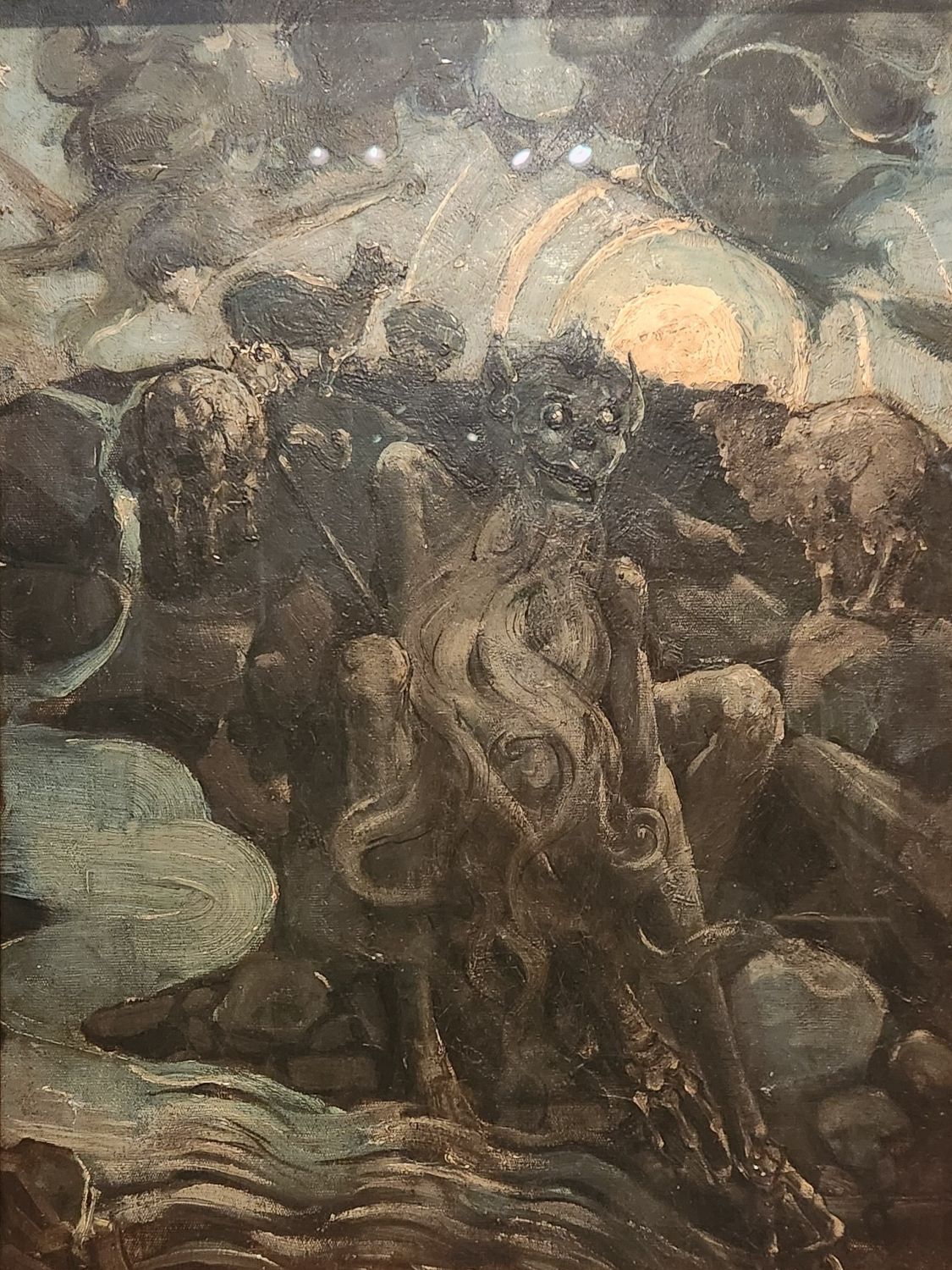
“The Brownie of Blednoch” (1889) by E.A. Hornel – Kelvingrove Art Gallery and Museum, Glasgow, U.K.
Working with the Shadow in Therapy

Working with the shadow in the context of Jungian psychotherapy is not a straightforward task, because we are not consciously aware of our shadow by definition. What we pay attention to instead are instances of heightened emotional reactions, projections, repetitive patterns, instances of ego-inflation, instances of sudden resistance or shut down, and of course dream images. The focus is on making the unconscious conscious, which is often experienced as destabilizing by the ego structure we rely on to navigate the day-to-day world.
By becoming conscious of what lies in our shadow, we indeed have to reckon with the fact that we are much more than what we think we are: we have much deeper potential and not-yet-developed qualities, and we also are much more morally ambiguous than we like to admit. Robert A. Johnson refers to these two aspects of the shadow as “golden” and “dark” respectively. He adds that, surprisingly, working on the golden shadow can prove harder than facing the dark shadow. This is because realizing what we are actually capable of achieving and contributing implicitly invites us to manifest this calling into conscious life and to make some difficult decisions at a time when the ego just wants to hold on to what is familiar, seemingly easy and comfortable (in Owning your own shadow, 1991, p.8):
“To draw the skeletons out of the closet is relatively easy, but to own the gold in the shadow is terrifying. It is more disrupting to find that you have a profound nobility of character than to find out you are a bum. Of course you are both: but one does not discover these two elements at the same time. The gold is related to our higher calling, and this can be hard to accept at certain stages of life. Ignoring the gold can be as damaging as ignoring the dark side of the psyche, and some people may suffer a severe shock or illness before they learn how to let the gold out.”